Winds | A Saturday Convening
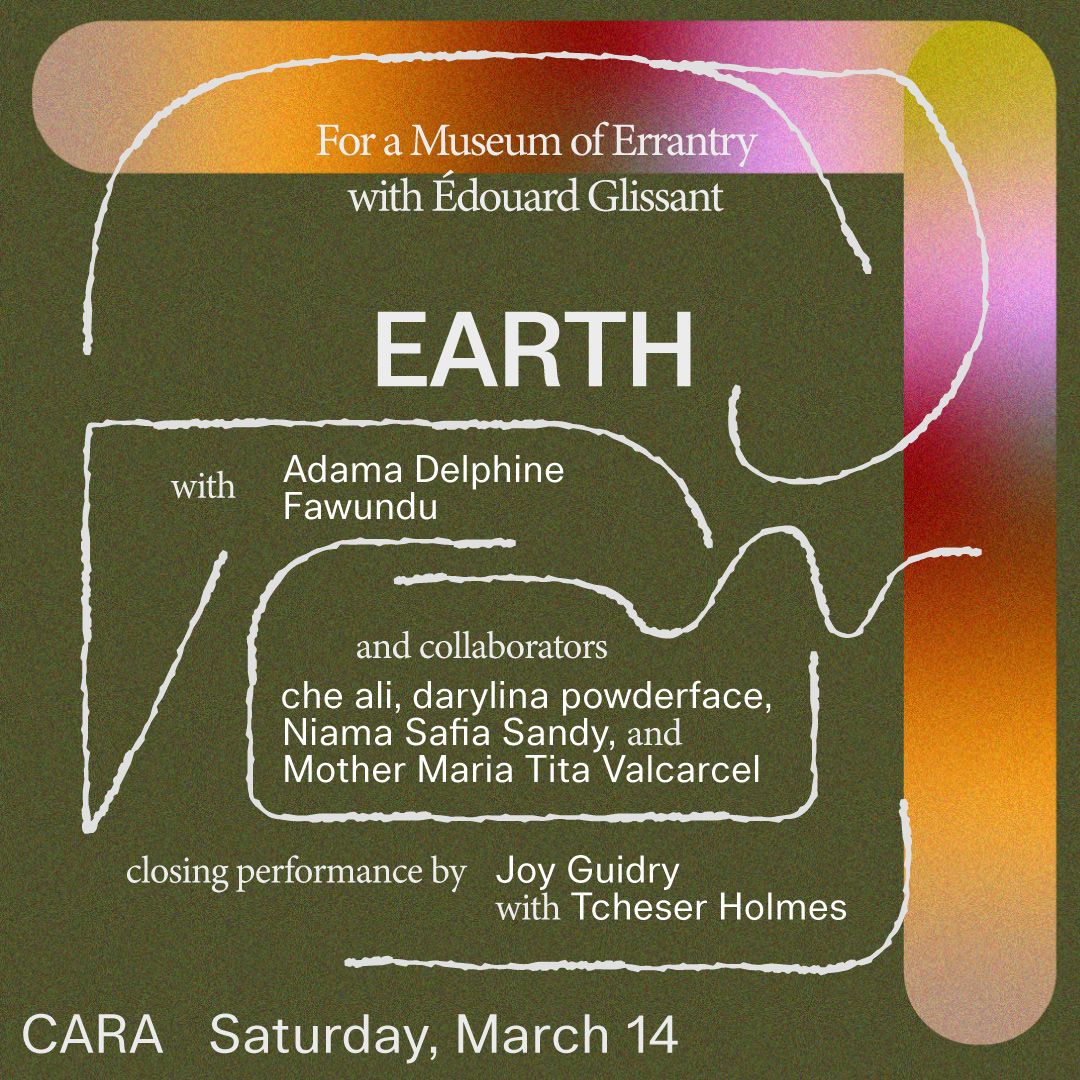
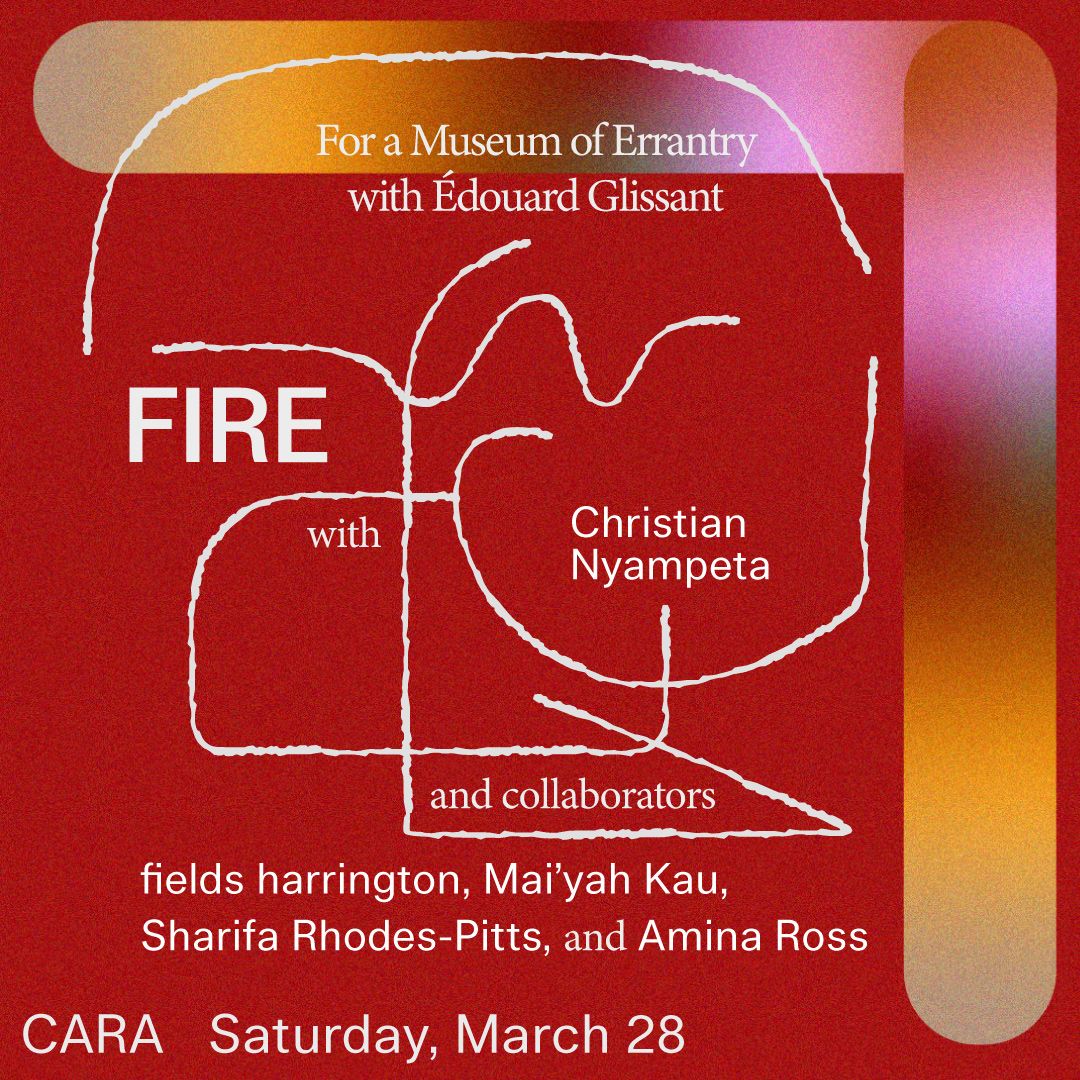
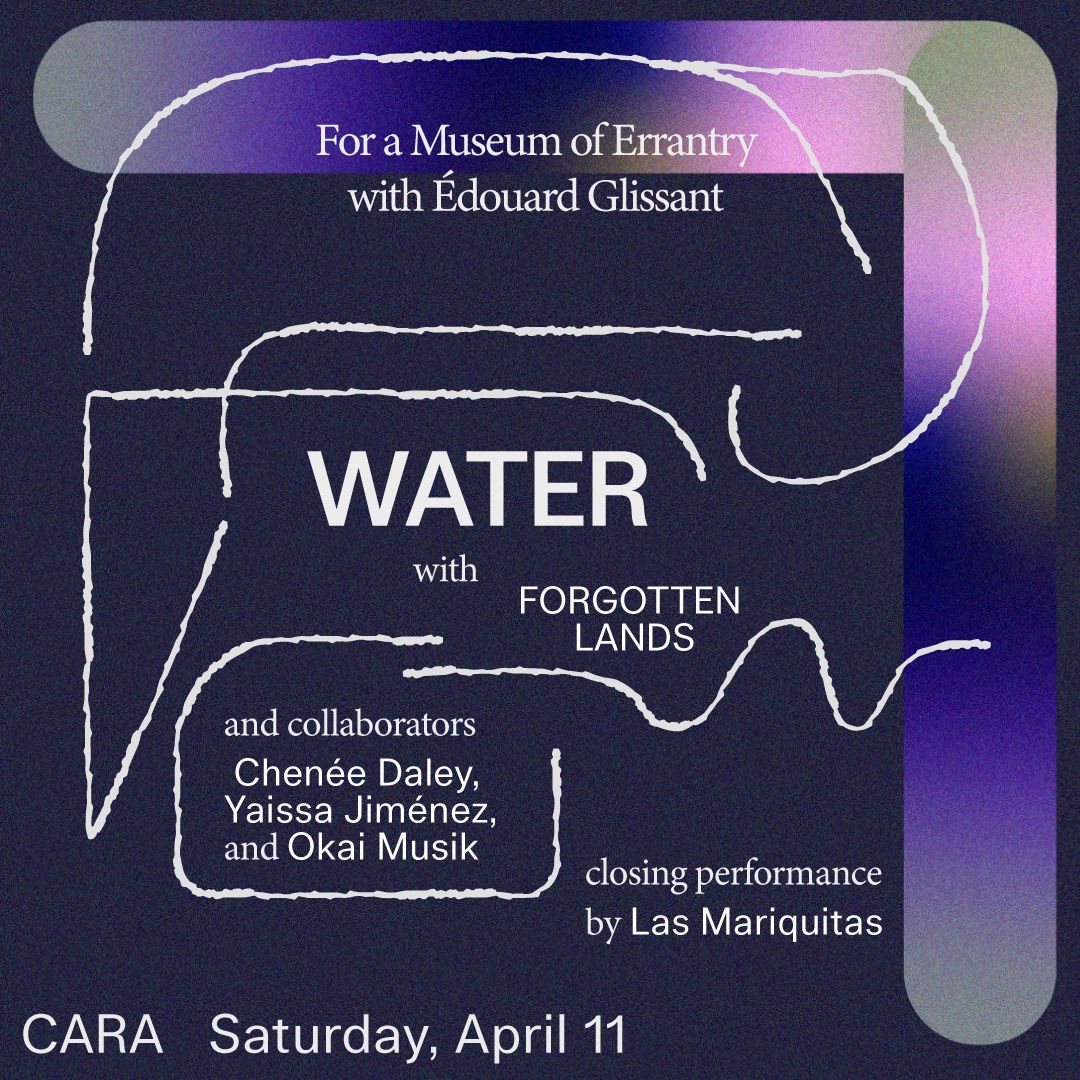
The Earth, the Fire, the Water, and the Winds: For a Museum of Errantry with Édouard Glissant unfolds as four Saturday convenings, featuring invited artists whose practices engage Glissant’s thinking, their collaborators and communities, and special musical guests. These programs respond to earth, fire, water, and winds through dialogue, shared poetics, and polyvocality.
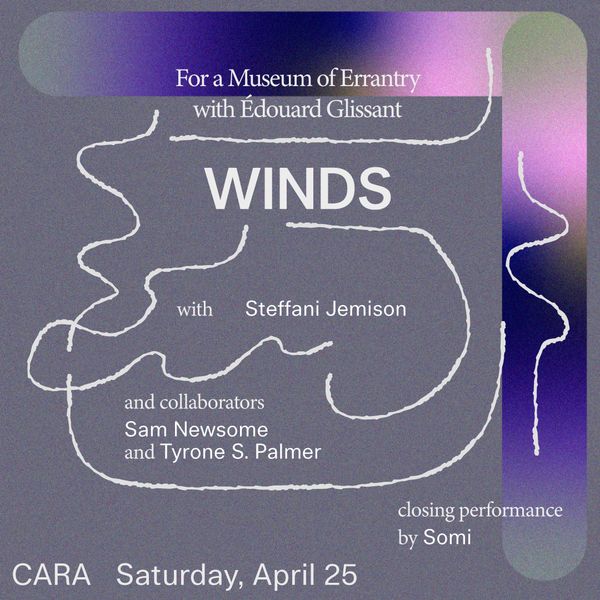
We conclude with winds on Saturday, April 25 at 4pm, considering breath, dispersal, the unseen, translation. A member of CARA’s curatorial team opens the afternoon with a reading from Édouard Glissant’s work.
Attuned to the poetics of speech and silence, artist Steffani Jemison evokes three registers of wind: wind as breath, wind as force, and wind as atmosphere. These ideas unfurl through a conversation with writer and critical theorist Tyrone S. Palmer alongside a performance by improvisational saxophonist Sam Newsome.
Jazz vocalist-composer Somi deepens this exploration of voice as embodied knowledge through a special closing set, accompanied by musicians Milena Casado and Devon Gates.
Steffani Jemison is an interdisciplinary artist and writer in Brooklyn, New York. In dialogue with interlocutors (living and ancestral), her work connects mark-making, gesture, proposal, projection, and movement.
Her work has been presented in solo exhibitions at Lafayette Anticipations, Paris, France (2025); Wadsworth Atheneum, Hartford, Connecticut (2025); Contemporary Art Center, Cincinnati (2021); Stedelijk Museum, Amsterdam (2019); Jeu de Paume, Paris (2017); and Mass MoCA, North Adams, Massachusetts (2017). The recipient of a Guggenheim Fellowship and a Creative Capital Award, Jemison is Associate Professor of Art & Design at Rutgers University.
Her work is included in the collections of the Art Institute of Chicago; Baltimore Museum of Art; Brooklyn Museum, New York; Buffalo AKG Art Museum, New York; Castello di Rivoli Museo d’Arte Contemporanea, Turin; Hirshhorn Museum and Sculpture Garden, Washington, DC; Kunstmuseum den Haag, The Hague; The Metropolitan Museum of Art, New York; The Museum of Modern Art, New York; Serralves Museum, Porto; Solomon R. Guggenheim Museum, New York; Stedelijk Museum, Amsterdam; The Studio Museum in Harlem, New York; and the Whitney Museum of American Art, New York, among others.

Sam Newsome is an improviser of extraordinary vision, renowned for his deep exploration of sound and the limitless potential of the soprano saxophone. His approach moves beyond conventional melody and harmony into the realms of texture, resonance, and rhythmic architecture. Through innovative prepared saxophone techniques—incorporating materials such as plastic tubes, hanging chimes, and balloons—Newsome transforms his instrument into a multidimensional sound source, redefining the expressive possibilities of improvisation and sculpting sonic landscapes that feel immediate, intimate, and timeless.
Critics have described Newsome as a “sonic architect,” an artist who builds immersive musical environments in real time. JazzTimes has called his work an “audacious, thrilling journey,” with each performance unfolding from a deeply meditative space. His landmark recording Sopranoville: Works for Prepared and Non-Prepared Saxophone (2017) was hailed by DownBeat as a “masterpiece” and named one of the Best Albums of the Year. His follow-up, Chaos Theory: Song Cycles for Prepared Saxophone (2019), further expanded the instrument’s vocabulary, earning praise for its fearless experimentation and structural depth.
Continuing his prolific output, Newsome released two duo recordings in 2024: Soprano Logs, a collaboration with saxophone legend Dave Liebman, and Cosmic Unconsciousness Unplugged, a duo with pianist Jean-Michel Pilc—both projects further documenting his ongoing exploration of spontaneous composition and deeply interactive musical dialogue.

Tyrone S. Palmer's teaching and research concerns Black critical thought, poetics, and negativity. His current book manuscript, “Felt Antagonisms: Blackness, Negativity, and the Grammars of Affect,” explores how key Black literary texts theorize the failures of a universalist conception of affect to account for the grammars of feeling that emerge from the singularity of Blackness. Palmer’s scholarship has previously been published or is forthcoming in Qui Parle: Critical Humanities and Social Sciences, Critical Ethnic Studies, Philosophy Today, TOPIA: Canadian Journal of Cultural Studies, Post-45, Discourse, and the edited volume The Affect Theory Reader II: Worldings, Tensions, Futures. In addition to his scholarly work, Palmer has published cultural criticism and poetry in a number of venues, including The New Inquiry, Gawker, The Offing, and Callaloo.

Vocalist, composer, actor, and playwright Somi Kakoma is the daughter of immigrants from Uganda and Rwanda. A true renaissance woman, she is known in the jazz world simply as Somi. Her fifth studio album, Zenzile: The Reimagination of Miriam Makeba, is a companion project to the critically acclaimed original musical “Dreaming Zenzile” that Somi also wrote and starred in Off-Broadway as a tribute to the great South African singer and activist. Prior to Zenzile and at the height of the 2020 global lockdown, Somi released an unplanned live album called Holy Room featuring the Frankfurt Radio Big Band that ultimately earned her a 2021 Grammy® nomination for Best Jazz Vocal Album and made her the first African woman ever nominated in any of the Grammy® jazz categories.
Somi is a recipient of the Doris Duke Artist Award, two NAACP Image Awards for Best Vocal Jazz Album, and the inaugural Jazz Music Award for Best Vocal Performance. She is also a Soros Equality Fellow, a United States Artist Fellow, a TED Senior Fellow, a Sundance Theatre Fellow, and the founder of Salon Africana – a boutique cultural agency and record label. Somi recently made her Broadway debut in the titular role of the TONY Award winning play “Jaja’s African Hair Braiding.”
Somi holds degrees in Cultural Anthropology and African Studies from University of Illinois at Urbana-Champaign, a Master’s degree in Performance Studies from Tisch School of the Arts at NYU, and is currently a PhD Candidate at Harvard University. In her heart of hearts, she is an East African Midwestern girl who loves family, poetry, and freedom.

Programs are free and open to all with RSVP encouraged.
Please note that your RSVP does not guarantee entry. Admission is on a first come, first served basis (even for those who have registered) and will be limited to the capacity of the venue. We encourage RSVPs to gauge interest in our programs.
We ask that visitors stay home if they are feeling sick or have tested positive for COVID-19 in the past 10 days. Testing before joining us at CARA is recommended. Masks will be available for free.
The closest wheelchair accessible subway is the 14th Street/8th Avenue station. The entrance to CARA is ADA-compliant, and our bookstore and galleries are barrier free throughout, with all-gender, wheelchair accessible restrooms. CARA has wheelchairs available for guest use. Please request one in advance via bookstore@cara-nyc.org. Service animals are welcome.