The Earth, the Fire, the Water, and the Winds: For a Museum of Errantry with Édouard Glissant
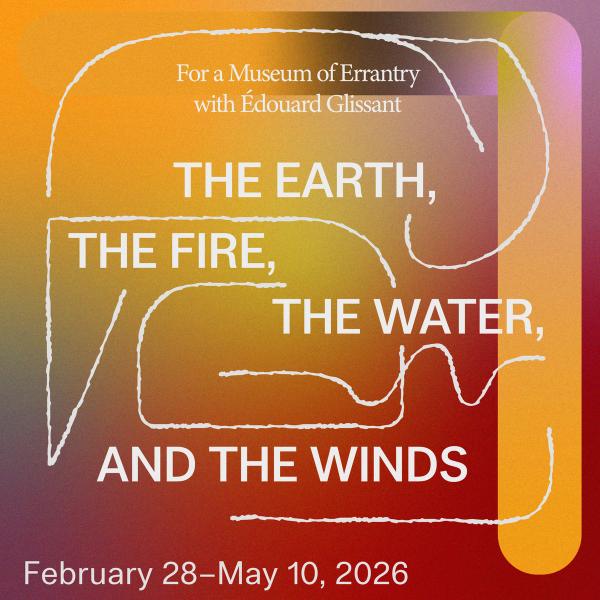
This spring, CARA presents The Earth, the Fire, the Water, and the Winds: For a Museum of Errantry with Édouard Glissant—the first US exhibition of the Martinican poet and philosopher Édouard Glissant's (1928–2011) personal art collection.
Traveling from Instituto Tomie Ohtake in São Paulo, Brazil, The Earth, the Fire, the Water, and the Winds reveals a lesser-known dimension of Glissant’s life: his vision for a museum. He conceived of it not as a monument, but as a space capable of holding art, memories, and intertwined histories without reducing them to colonial frameworks.
Errantry, central to Glissant’s thinking and this vision for a museum, is movement, encounter, and reinvention. It unfolds through the crossing of borders—geographic, linguistic, and historic—and resists the pull toward singular origins or stories. Glissant imagined both the world and the museum as an archipelago: a constellation of islands that live side by side, exchanging while remaining distinct.
Assembled across six decades, Glissant’s personal art collection traces both the beginnings of this museum and the breadth of his intellectual friendships and collaborations. In post-occupation France, particularly through the Surrealist scene and Galerie du Dragon (1955–1995), Glissant encountered artists from Africa, Europe, and the Americas who approached art as a journey of displacement, renewal, and solidarity. He gathered these works not for ownership, but in the spirit of the commons, imagining them as the beginnings of a living archive attentive to relation and difference.
Artists on view include Victor Anicet, Victor Brauner, Ernest Breleur, Agustín Cárdenas, Gerardo Chávez, Manthia Diawara, Melvin Edwards, M. Emile, Öyvind Fahlström, José Gamarra, Sylvie Séma Glissant, Serge Hélénon, Wifredo Lam, Roberto Matta, Paul Mayer, Gabriela Morawetz, Irving Petlin, Cesare Peverelli, Pancho Quilici, Antonio Seguí, Eduardo Zamora, and Enrique Zañartu. These artists embrace landscape not as a background but as an active force moving through gesture and memory, similar to Glissant’s conception of la parole du paysage, or “the word of the landscape.”


A publication of the same name offers expanded points of entry into Glissant’s thinking and collecting. Edited by Ana Roman and Paulo Miyada, the volume gathers essays, archival fragments, visual documents, and artist entries that trace the diasporic, migratory, and relational trajectories present in the works. It includes never-before-published excerpts from L’Abécédaire d’Édouard Glissant (2008), his recorded dialogue with Martinican writer Patrick Chamoiseau, as well as a facsimile of Notebook of a Journey on the Nile (1988), a poetic-philosophical travelogue composed during his journey through Egypt.
Glissant’s work reckons with the long afterlives of colonization by attending to the poetics, experiences, and discourses of Black life in the Caribbean. From the landscapes of Martinique, he developed the theory of the Tout-Monde, a world shaped by relation, intersecting geographies, histories, and temporalities. For Glissant, all forms of knowledge are entangled, including those held in the textures of a poem, the histories of an acoma tree, and the languages and sensibilities embedded in works of art.
From Martinique to Paris, New York, and beyond, the writer’s migratory life shaped this vision. CARA’s presentation of the exhibition marks one iteration in a broader journey of errantry, attuned to and speaking from the context of New York City.
The Earth, the Fire, the Water, and the Winds: For a Museum of Errantry with Édouard Glissant at CARA is curated by Manuela Moscoso, Executive and Artistic Director, with curatorial assistance by Marian Chudnovsky, in collaboration with Paulo Miyada, Artistic Director, Instituto Tomie Ohtake, and Ana Roman, Artistic Superintendent, Instituto Tomie Ohtake. The exhibition is co-conceived with Mémorial ACTe, the Édouard Glissant Art Fund, and the Institut du Tout-Monde.


Installation views by Kris Graves
Opening Celebration
Saturday, February 28, 2026
4–7pm
Book Launch & Conversation
Thursday, March 5, 7pm
Join the publication's editors, Paulo Miyada and Ana Roman; exhibition artist and Director of the Institut du Tout-Monde, Sylvie Séma Glissant; and CARA's Executive and Artistic Director, Manuela Moscoso, for a conversation that further explores the genesis of this project and Glissant's conception of the museum as an archipelago.
Four Saturday Convenings
The Earth, the Fire, the Water, and the Winds unfolds as four Saturday convenings, featuring invited artists whose practices engage Glissant’s thinking, their collaborators and communities, and special musical guests. These gatherings respond to earth, fire, water, and winds through dialogue, shared poetics, and polyvocality.
Earth
Saturday, March 14, 4pm
with Adama Delphine Fawundu and collaborators che ali, darylina powderface, Niama Safia Sandy, and Mother Maria Tita Valcarcel; closing performance by Joy Guidry with Tcheser Holmes
Fire
Saturday, March 28, 6pm
with Christian Nyampeta and collaborators fields harrington, Mai’yah Kau, Sharifa Rhodes-Pitts, and Amina Ross
Water
Saturday, April 11, 4pm
with FORGOTTEN LANDS and collaborators Chenée Daley, Yaissa Jiménez, and Okai Musik; closing performance by Conjunto Coqui de Las Mariquitas
Winds
Saturday, April 25, 4pm
with Steffani Jemison and collaborators Sam Newsome and Tyrone S. Palmer; closing performance by Somi with Milena Casado and Devon Gates
Exhibition Walkthroughs
The curatorial team will offer guided walkthroughs of The Earth, the Fire, the Water, and the Winds on the following dates:
Thursday, March 26, 6pm
Thursday, April 2, 6pm
Saturday, May 9, 4pm
Research Page
After Édouard Glissant’s Abécédaire
Marian Chudnovsky and Rachel Valinsky
Abécédaire: Alphabet
Nolan Oswald Dennis, Chang Yuchen
Abécédaire: Creolization
Miho Hatori, Kaiama L. Glover, Michel DeGraff
Abécédaire: Errantry
Sónia Vaz Borges, Christopher Rey Pérez
Abécédaire: Tremors
Miryam Charles, Pat Noxolo, Olivier Marboeuf