Abécédaire: Alphabet
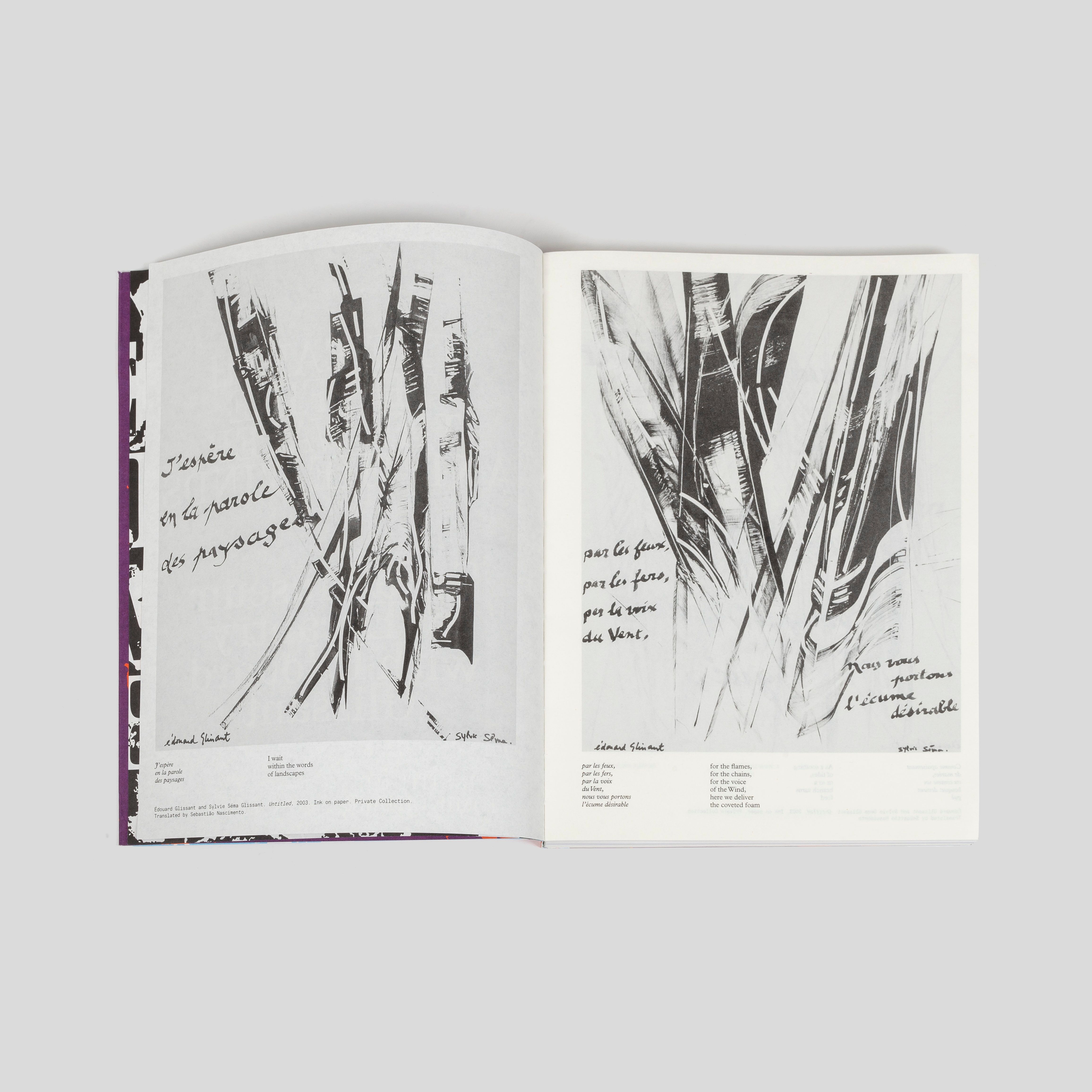
“The landscape is the country’s poem.” —Édouard Glissant
Nolan Oswald Dennis
Dividing language into small images in order to convert something heard into something seen is no simple task. An alphabet compiles graphic-sonic conjunctions to bind discrete drawings, called letters, to particular sounds (however inconsistent). The internal logics that govern the sequence of letters are just as, if not more important than, the graphic-sonic logic. A pre-grammatical hierarchy. The alphabet has rules that precede language; ABCDs are language-agnostic. French, English, Zulu all surrender to the order of the alphabet: A to Z. This alpha-beta . . . zeta index has a Greek history, which has a Phoenician history, which has an Egyptian history—but that’s another story.
The sound-to-letter relation is complex and treacherous. Letters propose a stable and recognizable pattern in the alphabetical order of our lives. A set of rules for constructing shapes and determining their sequence within the silence of a reading eye. Sound deposes this order, emerging from and merging with the polyrhythms of language, the traces of mother tongues, the ambiguity of your “A” which echoes with the power relations of pronunciation. Hearing, too, is filtered through knowledge and experience, theory and practice, yours or ours, modulated by the enforcement of recognition. Can you repeat that? The noisiness of our speaking mouths nurtures misrecognition. A cage and a shield in the LMNOPs of our lives.
Pronunciation is distinctly relational. To pronounce one’s self for one’s self. Legibility and elocution require a second, third, or fourth system. Domination. Sound reaffirms the sociogenic properties of language. The rules of sound are disciplined within the body; the ear must learn to hear and the mouth to enunciate. Consistently. Read. But speak well, or better, you speak so well. The violence of celebrating when we sound like you, who belong to the dominating world. The alphabet is accountable to this violence. It is better to know that the letters are also weapons, and like any weapon, that they can be turned against their masters.
Nolan Oswald Dennis is an artist based in Johannesburg, South Africa. Their practice explores the material and metaphysical conditions of decolonization, questioning histories of space and time through system-specific interventions. They hold a Bachelor’s degree in Architecture from the University of the Witwatersrand (Wits) and a Master’s degree in Art, Culture, and Technology from the Massachusetts Institute of Technology (MIT). Their work has been the subject of solo exhibitions at Kunstinstituut Melly in Rotterdam, Swiss Institute in New York, and Zeitz MOCAA in Cape Town. They have been featured in group exhibitions at FRONT Triennial, Cleveland; Lagos Biennial, Liverpool Biennial; MACBA, Barcelona; Palais de Tokyo, Paris; Seoul Mediacity Biennale; Shanghai Biennale; and Young Congo Biennale; among others. They are a member of the artist groups NTU and Index Literacy Program, a research associate with the VIAD Research Centre at the University of Johannesburg, and a member of the Edouard Glissant Art Fund Scientific Committee.
Chang Yuchen
People often think of Coral Dictionary—my ongoing project in which I compose a written language with coral bodies—as an alphabet. I often have to clarify: It is not alphabetical. It is a mixture of pictograms and ideograms. It concerns shape more than sound. Like Chinese, ancient Egyptian hieroglyphs, or emojis.
Over six years, this recurring conversation has made me realize how deeply Chinese my linguistic sensibility is, despite my decision to leave the country, despite the fact that Coral Dictionary began in Malaysia and developed in New York. The Chinese character for fire, 火, mimics rising flames. Water, 水, traces downward streams. Of course, I see meaning in shapes.
Yet, like Egyptian hieroglyphs, Chinese is an impure pictorial system; it has a phonetic dimension. In fact, the majority of Chinese characters are composed of phono-semantic compounds. Moreover, some ideograms are embedded with aurality: The character for poetry, 詩, combines 言 (speech) with 寺, a phonetic element also related to 志 (intention). The character for meaning, 意, is composed of 音 (sound) above 心 (heart). Sound on top of heart makes meaning.
Non-alphabetical writing was long considered “primitive.” Many linguists believed written language “evolves from the earliest stages of semasiography, in which pictures convey the desired meaning, to the later stage of phonography, in which writing expresses language.”1 In Understanding Media, Marshall McLuhan argued that the phonetic alphabet fundamentally restructures human perception and society. By separating the visual from the auditory, it “frees man from the tribal trance of resonating word magic and the web of kinship,” fostering a cool individualism and uniform legal order, leaving behind the holistic, sensory, and tribal social structure.2
In the early twentieth century, many progressive left-wing Chinese intellectuals, such as Lu Xun, sought to romanize the Chinese language and abolish Chinese characters. “Chinese characters are tuberculosis inhabiting the bodies of the working masses, the germs latent within,” wrote Lu Xun. “If it is not removed, the result can only be our own death.”3 Fueled by proletarian internationalism and the painful desire for modernity, Chinese characters were condemned as feudal decadence, as defective currency, as dead bodies; and people who held onto them as 骸骨迷恋, corpse-fetishists.
The coral debris I work with have long been dead: fragmented, dehydrated, and calcified. Yet I believe it is the fact that they were once alive that makes them expressive; their last gestures fossilize into a “meaning.” A corpse is not the opposite of vitality; it is also the evidence of and footnote to it.
“Writing is a technology,” writes Ted Chiang. “A literate person is someone whose thought processes are technologically mediated. We become cognitive cyborgs as soon as we become fluent readers.” Perhaps I am a pictorial cyborg installed with alphabetical software, and Coral Dictionary is a persistent glitch, where words are unlinked from sound and language unlinked from use. The unbroken link, however, exists between me and what was once here.
NOTES
1 Ignace J. Gelb, A Study of Writing, rev. ed. (Chicago: University of Chicago Press, 1963).
2 Marshall McLuhan, Understanding Media: The Extensions of Man (New York: Mentor, 1964), 96.
3 Lu Xun, “關於新文字” (1934), my translation.
Chang Yuchen works in an interdisciplinary manner—writing as weaving, drawing as translation, teaching as hospitality, commerce as social experiment (see Use Value), and publishing as a dandelion spreading its seeds. She is also an advocate for the art of her mother, Jin Mei. Yuchen is a recipient of the New York Public Library Picture Collection Artist Fellowship, Queens Art Fund New Work Grant, Poetry Project Curatorial Fellowship, and Luminarts Fellowship, among others. She has shown and performed her work at the Walker Art Center, Pioneer Works, Beijing Commune, The High Line, the Carnegie Museum of Art, Amant, Artists Space, Para Site, and Taikwun Contemporary. She has been an artist-in-residence at Triangle, Smack Mellon, Asymmetry Art Foundation, MASS MoCA, the Museum of Arts and Design, and the Robert Blackburn Printmaking Workshop. Yuchen currently teaches in the Dance MFA program at Bennington.