Abécédaire: Tremors
“Your thinking, and therefore your politics, must be tremorous, that is to say, it must sink here, rise there, branch off here, run along there, have a kind of operational hatch that allows it to engulf the constitutive hatch of the current world.” —Édouard Glissant
For Another World
Miryam Charles
There often seem to be two worlds that refuse to meet, or even to recognize one another.
I think about this disconnect often. About what I see and feel as a Black woman from Haiti, yet shaped largely by life in the West. Sometimes I wonder if my sensitivity to what surrounds me, my attention to people, to silences, to what remains unseen, comes precisely from that position. From having grown up between two languages, two ways of seeing, only to return to my mother tongue as an adult. A language I speak now with the accent of the country where I have spent the majority of my life, a language that carries tremors beneath its surface, subtle reminders that we are alive, that life will always shift, and that there will always be another path, another way of being.
From a very young age, I developed a gaze. Or was I forced to? A way of noticing what is not spoken about. Of lingering with what we are collectively taught not to see. That gaze carries tremors too: They are necessary. They remind us that we are alive, that nothing is fixed, that change is possible, and that other routes, other ways of living, always exist.
I often return to this fracture: on one side, people who suffer, who are oppressed, brutalized; on the other, a system in which life continues undisturbed by what is happening. A system in which we call ourselves free.
I think about utopia. About Édouard Glissant, who wrote that utopia is necessary. Utopia is not an escape from reality, but a gesture toward it. A way of reconnecting with our shared humanity, of reviving the desire to act for something larger than ourselves, and of creating spaces where empathy can still circulate. But utopia cannot exist without wandering. Not wandering as loss, but as possibility.
To wander freely is to step outside the paths that were drawn for us, paths often designed by others, and for others. Wandering becomes a form of resistance, a way of inventing new routes. Perhaps it is along these uncertain paths, carried by tremors that remind us we are alive, that we rediscover ourselves. That we begin to glimpse what a poetic life might look like. A life that could belong to all of us, if we allowed ourselves the space to exist together.
And perhaps on those new paths, utopia would no longer be a distant dream, but the fragile outline of a more just and open world.
Miryam Charles is a filmmaker of Haitian origin living in Montreal. Her films have been shown at various festivals in Quebec and abroad. Her first feature, Cette maison, premiered at the Berlinale, was presented at the AFI FEST, and was included in the TIFF Top 10 and Sight and Sound’s Best Films of the Year in 2022. Her work has been shown at the Musée d’art contemporain de Montréal; the Galerie Leonard & Bina Ellen Art, Montreal; the Everson Museum of Art, Syracuse, NY; basis, Frankfurt; and the Palais de Tokyo, Paris. In 2025, Miryam was the recipient of the inaugural Charles Officer Legacy Award, presented by TIFF and CBC. She is currently working on her next feature film, Vers le soleil ou plus près encore.
Pat Noxolo
Édouard Glissant’s “tremorous thought”1 speaks to a thoroughly entangled planet. As Glissant knew, subatomic particles remain entangled with one another, irrespective of distance.2 Here and there are ultimately inseparable. More uncannily, they are superpositioned, or located in many places at once. Since it is measurement that fixes their location, their superpositioned state is effectively “immeasurable.”3 This obscure unfixedness at the heart of matter makes for “obscure channels” that link our bodies directly to and across our “trembling world” and to each other.4
And yet, our planetary “throwntogetherness”5 highlights a rich diversity that instantaneous global communications have only just equipped humanity to begin to appreciate. Now that we can instantly livestream the diverse and “ongoing catastrophes”6 that constantly remake our scientific forecasts,7 we might turn again to Glissant for the greater “subtlety”8 he advocates in how to understand our planet. Such subtlety erases colonial master narratives that sought to define historical progress by “calculat[ing] . . . the flow of the world’s matter through time.”9
Loosening our planetary grip, we need the courage to tremble with the chaotic energy of the cyclone and the earthquake. To paraphrase Patrick Chamoiseau, History can no longer be smoothed into straight lines.10 All we have now is Time, untrained, “like a leashed dog that steps forward, rolls back, shivers, skids and takes a sharp right.” Glissant’s more seismic “thought” is an energy that can “sink here, rise there, branch off here, run along there,”11 bringing a more humanized and politicized spatial turn. Unlike Time, tremorous thought is not skittish or fearful. Drawing from the earthquake’s powerful mustering of the “energies in the living earth,”12 the tremor quivers with “possibilities for restorative change.”13 Only within bodies and minds that shimmy and shake the channels of entanglement can we hope to intuit the chaotic choreography of the megacity, or the enviro-climatic eruptions of our overworked planet.
Professor Pat Noxolo’s research brings together the study of international culture and in/security, and uses postcolonial, discursive, and literary approaches to explore the spatialities of a range of Caribbean and British cultural practices, including dance, visual arts, and literature. She was awarded the 2021 Royal Geographical Society (RGS) Murchison Award and chaired the RGS’s annual conference in 2025. She is a Fellow of the Academy of Social Sciences. Pat has led two international teams exploring Caribbean in/securities and creativity, funded by Leverhulme and by the Arts and Humanities Research Council, and she is co-lead of University of Birmingham’s Stuart Hall Archive Project. She commissioned the report “Supervising Black Geography PhD Researchers in the UK” (2021), and is co-founder and co-lead of the Fi Wi Road internships for Black Geography undergraduates.
NOTES
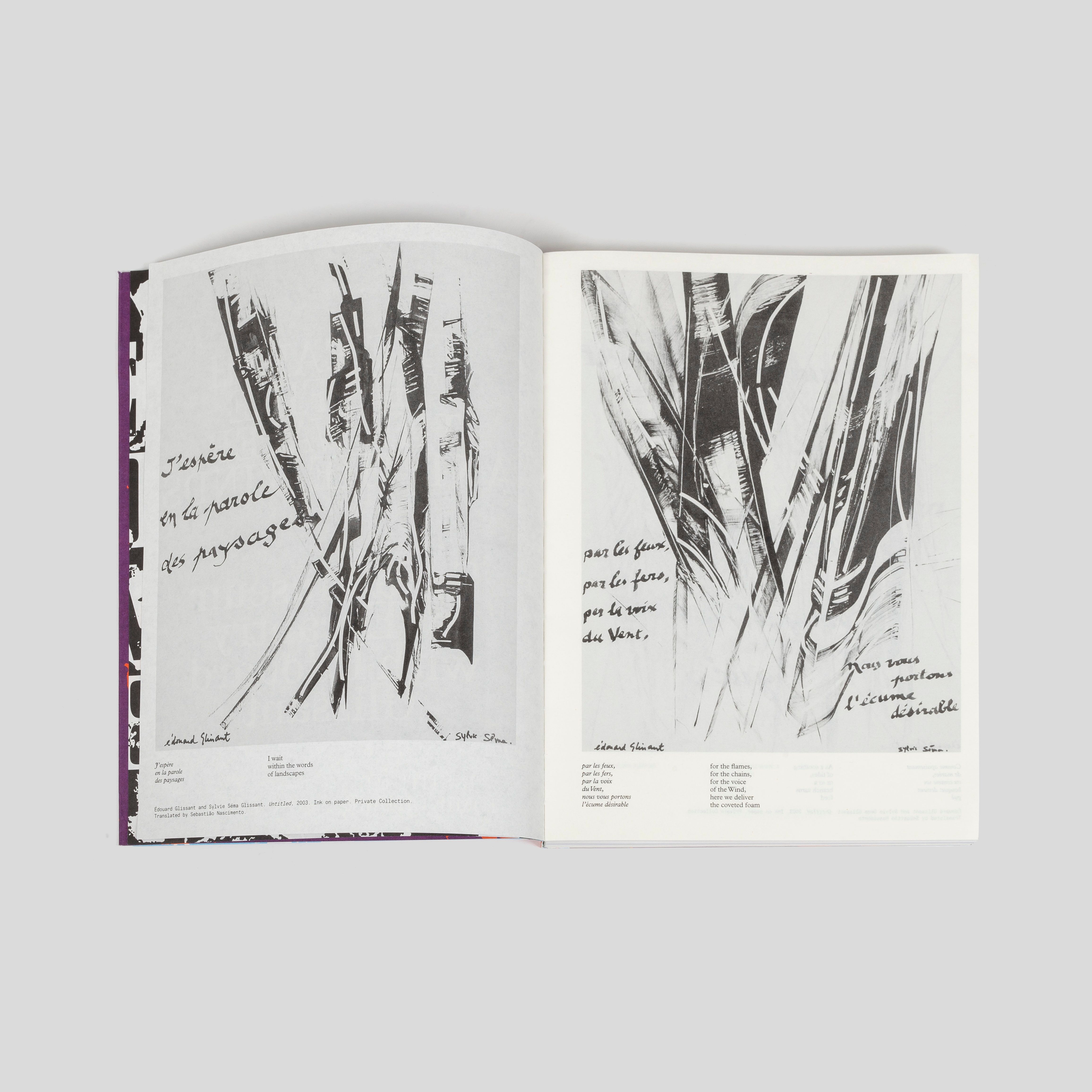
1 Édouard Glissant on “tremorous thought” in “Abécédaire: Édouard Glissant in Conversation with Patrick Chamoiseau,” recorded in January 2008, trans. Sebastião Nascimento, published in The Earth, the Fire, the Water, and the Winds: For a Museum of Errantry with Édouard Glissant (New York: CARA; São Paulo: Instituto Tomie Ohtake, 2025), 60.
2 See Pat Noxolo, “Quantum Black Creative Geographies: Embodiment, Coherence and Transcendence in a Time of Climate Crisis,” Singapore Journal of Tropical Geography 46, no. 1 (2025): 6–17.
3 Glissant, “Abécédaire,” 60.
4 Édouard Glissant, introduction to Caribbean Discourse: Selected Essays, trans. J. Michael Dash (Charlottesville: University Press of Virginia, 1989), 2.
5 Doreen Massey, For Space (London: Sage, 2005), 140.
6 Glissant, “Abécédaire,” 61.
7 Alexandra Witze, “The Pace of Climate Change Is Speeding Up – The Pace Nearly Doubled in Ten Years,” Nature 651 (March 2026): 569–70.
8 Glissant, “Abécédaire,” 60.
9 Ibid.
10 Patrick Chamoiseau, Texaco, trans. Rose-Miryam Réjouis and Val Vinokurov (New York: Pantheon Books, 1997), 293.
11 Glissant, “Abécédaire,” 61.
12 Wilson Harris, Selected Essays of Wilson Harris: The Unfinished Genesis of the Imagination, ed. Andrew Bundy (London: Routledge, 1999) 187.
13 Glissant, “Abécédaire,” 61.
Tremble
Olivier Marboeuf
English
Translated by Rachel Valinsky
Tremble
through the skin’s
open pores
Tremble
through the golden rays at the back of the neck
Tremble
through the torrent of sweat
the icy liquids of a body
Tremble
through the contractions of muscles
somewhere
in the pelvic floor
Tremble
through the agitation of the leg
that can no longer find ground
through the knots in the stomach
and the warm places
of dance
Tremble
through the heel
seized by a bigidi without end
in the wild eye of a léwoz
Tremble
with the surround
and the friendly smell
of fire
This is how you know
How you already know
And how you know anew
Tremble
in the frequencies
of hushed voices
that await
Tremble
through the swollen skin
of a drum beat
Tremble
and welcome
what comes
without a face
or custody
Tremble
and welcome
without screening
the undocumented smoke
the liquid life
that passes through
police
hands
Tremble
This is how you know
How you already know
How you know anew
and how you tremble still
solidarity
in your bones
from all the sleepless
nights
Tremble
through the landfill
of a landscape
on the curve of a bare arm
that foresees
the coming risk
and unmasks
bad faith
Tremble
and cross the street
flee debt
and false friends
So, tremble
and cut up the night
with your laser hips
Hug the walls
Hands warmed
by a fire
will do the trick
tonight
Tremble
and welcome
lips
tasting of mango
yam mashed by teeth
pomegranate
and the garden
a finger
making signs
that no one
can control
It isn’t fear
that makes you tremble
it is the train of the world
on your damp temple
and the voices of those
who spun
wild embers
in the old film
of shame
It is the solid life
without comfort
the breath in the fists
that break up syntax
Tremble
and have no regrets
A hematoma in the mouth
an unconceding accent
the landfill of memory
and the memory
of the fires
Tremble
Tremble
landscape an nou
entered by effraction
Tremble
toppled statue
the old history
is laid to rest
Tremble
birds that fly
toward the remains of the past
Tremble
this vibration
without a master
is our archive
in the future
Olivier Marboeuf is an author-storyteller, artist, independent curator, cultural theorist, and film producer from Guadeloupe (French Caribbean). He is one of the leading figures in decolonial thought and struggles across the French-speaking world. In the early 1990s, together with French-Beninese author Yvan Alagbé, he founded éditions Amok (now Frémok), an experimental comics publisher. From 2004 to 2018, he was the artistic director of Espace Khiasma, a visual arts and living literature center based in the outskirts of Paris dedicated to minority representations, which contributed to introducing postcolonial theories to the French art scene through numerous exhibitions and programs. From 2013 to 2024, he was also a film producer with Spectre Productions, producing some sixty artists’ films and documentaries in all formats. He currently divides his time between writing, drawing, and activities linked to collaborative art practices. He is a founding member of the Independent Network of Workers and Actors in Visual Arts (RITAA) in Guadeloupe.
Tremble
Olivier Marboeuf
French
Tremble
par les pores ouverts
de la peau
Tremble
par les rayons dorés sur la nuque
Tremble
par le torrent de la sueur
par les liquides glacés d’un corps
Tremble
par les contractions des muscles
quelque part
sur le plancher pelvien
Tremble
par l’agitation de la jambe
qui ne trouve plus le sol
par les nœuds dans l’estomac
et les endroits chauds
de la danse
Tremble
par le talon
saisit d’un bigidi sans fin
par l’oeil fou d’un léwoz
Tremble
avec l’entour
et l’odeur amicale
du feu
C’est comme ça que tu sais
Que tu sais déjà
Et que tu sais de nouveau
Tremble
dans les fréquences
des voix basses
qui espèrent
Tremble
par la peau gonflée
d’un coup de tambour
Tremble
et accueille
ce qui vient
sans visage
ni garde à vue
Tremble
et accueille
sans contrôle d’identité
la fumée sans papier
la vie liquide
qui traverse
les mains
de la police
Tremble
C’est comme ça que tu sais
Que tu sais déjà
Que tu sais de nouveau
et que tu trembles encore
solidaire
dans tes os
de toutes les nuits
sans sommeil
Tremble
par la décharge
d’un paysage
sur la ligne d’un bras nu
qui voit venir
le risque
et démasque
la mauvaise foi
Tremble
et change de trottoir
fuis la dette
et les faux amis
Tremble donc
et découpes la nuit
au laser de tes hanches
Rases les murs
Les mains chaudes
d’un feu
feront l’affaire
ce soir
Tremble
et accueille
les lèvres
au goût de mangue
l’igname brisé des dents
la grenade
et le jardin
le doigt
qui fait des signes
que personne
ne gouverne
Ce n’est pas la peur
qui te fait trembler
c’est le train du monde
sur ta tempe mouillée
et les voix de ceux
qui tournaient sur eux-mêmes
braises folles
dans le vieux film
de la honte
C’est la vie solide
et sans confort
le souffle dans les poings
qui découpe la syntaxe
Tremble
et ne regrette rien
L’hématome dans la bouche
l’accent sans concession
la déchetterie de la mémoire
et la mémoire
des incendies
Tremble
Tremble
paysage an nou
entré par effraction
Tremble
statue qui tombe
la vieille histoire
va se coucher
Tremblent
oiseaux qui volent
vers les restes du passé
Tremble
cette vibration
sans maître
c’est notre archive
dans le futur